
PARAGON SPORTS CONSULTING
Menu ☰

Jayden Kurtz has steadily transformed from a promising Minnesota high school player into one of the most intriguing defensemen available in the 2026 NHL Draft.

While his combination of size, skating ability, and hockey intelligence has already attracted NHL attention, those who know him best believe his ceiling remains considerably higher.

“I think I’m a really well-rounded 200-foot defenseman right now, and I’m only going to keep getting better,” Kurtz said. “I’ve only been playing defense full time for three years, so I feel like I’m just scratching the surface.”

The 6-foot-3, 190-pound right-shot defenseman from Rogers High School enters the draft after earning the highest ranking among Minnesota high school players on NHL Central Scouting’s final North American skater list, checking in at No. 61. Many evaluators project him as a second or third-round selection.

Rather than leaving high school early, Kurtz chose to finish his senior season in Rogers, following a path that several successful Minnesota players have taken before him.

“There have been a lot of Minnesota players who stayed for their senior year,” Kurtz said. “Getting one last season with your teammates, your friends, and your community made it a special experience.”

Kurtz served as an alternate captain during his senior campaign, recording 13 goals and 25 assists for 38 points in just 26 games. His performance earned him recognition as a finalist for Minnesota’s prestigious Mr. Hockey Award, presented annually to the state’s top senior player.

In addition to his high school success, Kurtz gained valuable experience with the Chicago Steel of the USHL, where he contributed one goal and two assists while generating 30 shots on goal across 16 games. He is expected to return to Chicago next season before beginning his collegiate career at the University of Wisconsin.

NHL Central Scouting evaluator Pat Cullen believes Kurtz’s development has accelerated throughout the season.

“He really emerged as one of the players we kept coming back to,” Cullen said. “He’s a big, skilled right-shot defenseman who plays smart hockey, contributes offensively, and is reliable defensively. He’s still developing, which makes him an exciting prospect.”

That continued growth comes as no surprise to Rogers High School head coach Dave Brown, who has coached Kurtz since before high school. Brown recalls that Kurtz’s path required patience, as his December birthday often meant competing against older, more physically mature players.

“He had to stay with it while others developed earlier,” Brown said. “Now he’s become one of the best players I’ve ever coached.”

Interestingly, Kurtz originally made his name as a forward. Brown believed his offensive instincts would translate even better from the blue line and encouraged him to make the switch before his sophomore season.

“I told him he could become one of the best forwards in the state,” Brown said. “But as a defenseman, I believed he had NHL potential.”

The transition has proven to be a pivotal moment in Kurtz’s development.

Today, he is trusted in every game situation, whether quarterbacking the power play, killing penalties, or logging heavy minutes against top competition. Coaches consistently praise his ability to process the game quickly and make the right decision under pressure.

“He understands what’s happening on the ice before most players do,” Brown said. “He doesn’t have to think about what he’s supposed to do. He simply reads the play and reacts.”

His brief experience with the Chicago Steel further strengthened his confidence. Rather than simply adjusting to the speed of junior hockey, Kurtz quickly demonstrated that he could handle the pace while contributing in transition and managing difficult defensive assignments.

Looking ahead, Kurtz is eager to spend a full season under Chicago Steel head coach Scott Gomez, whose NHL experience provides another valuable learning opportunity.

“I’m excited to learn from Coach Gomez,” Kurtz said. “He has so much NHL experience, and I want to keep asking questions and continue improving every day.”

Off the ice, Kurtz has dedicated significant time to physical development. Over the past two offseasons, he has added nearly 40 pounds while committing to weekly power-skating sessions designed to improve his explosiveness and mobility.

“As a bigger defenseman, skating is one of the biggest parts of your game,” Kurtz said. “You have to continue improving if you want to compete at higher levels.”

Brown has also watched Kurtz evolve into a vocal leader.

Although he didn’t wear a letter as a junior, Kurtz became one of Rogers’ emotional leaders during his senior season, particularly in pressure-filled moments.

“When the biggest moments came, his leadership really stood out,” Brown said. “He has a way of making the players around him better.”

As NHL organizations finalize their draft boards, Kurtz continues to generate significant interest across the league.

“I’ve talked with a lot of NHL teams about Jayden,” Brown said. “You can hear the excitement in their voices. They believe he’s a player with a very bright future.”

With another season of junior hockey ahead before arriving at Wisconsin, Kurtz appears well positioned to continue his upward trajectory as one of the most promising young defensemen in the 2026 draft class.
NOVAK DJOKOVIC first picked up a tennis racket when he was four years old. At the age of 12 he left his native Serbia for a tennis academy in Germany. He won his first major title—the 2008 Australian Open—when he was 20. Today he has another 23 majors under his belt, and has spent more time ranked number one in the world than any other player.

Mr Djokovic’s illustrious career fits a common idea of human excellence: a child prodigy, schooled intensively in his early years, goes on to conquer his chosen field. But a paper published in Science at the end of last year suggests he may be something of an exception, rather than the rule. It concludes that the very best performers, in all sorts of fields beyond just sport, tend to follow a rather different path.

This study, led by Arne Güllich, a sports scientist at the RPTU University Kaiserslautern-Landau, in Germany, crunched data covering more than 34,000 elite performers in several areas, including sport, chess, classical music and academia. It concluded that, although they often reach a high level, the best-performing, most intensely drilled teenagers tend not to become true superstars as adults. Those who do make that grade, by contrast, tend not to stand out early on. They take longer to reach their peaks and seem to keep their interests wider for longer.

It is no accident that both Dr Güllich and one of his co-authors are sports scientists (the other two are psychologists). Sport makes a good laboratory in which to study how excellence develops. There is no shortage of volunteers, in the form of talented youngsters dreaming of making it big. Performance is easy to measure. And, since spotting future stars is vital for professional teams, there are many well-funded youth academies.

The received wisdom—and the logic on which the academies are based—is that the best way to nurture talented youngsters is to identify them early and drill them relentlessly. But a lot of the research backing that approach had looked only at school or university-level athletes, says Dr Güllich. It had not followed its subjects into their professional, adult careers.

Some more recent studies have, however, done this. Dr Güllich and his colleagues collected them and found the beginning of their new hypothesis—for all these studies agreed the received wisdom was wrong, and that early performance was not a reliable predictor of adult outcomes. Thus jolted into action, they extended the analysis beyond the sports field and came to similar conclusions.

Gathering data for other fields of endeavour took them two years. Chess was fairly straightforward. Both national and international chess outfits maintain so-called Elo ratings of players. These give a numerical assessment of those players’ strengths. Academics can similarly be ranked via databases that use citations of their work as a proxy for how influential it is, as well as by the award of prizes such as the Nobels or the Fields medal.

Music was the trickiest, says Dr Güllich. For this, he and his colleagues relied in part on a study carried out at the University of California, Davis, which tried to rank classical composers using expert consensus, mentions in musical encyclopaedias and (for those who wrote such things) how often their operas have been performed in the world’s best opera houses.

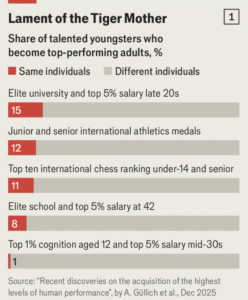
When they crunched their data, a reliable pattern fell out. In every field, elite youth performers and elite adults were almost entirely separate groups. Around 90% of superstar adults had not been superstars as children, while only 10% of top-level kids had gone on to become exceptional adults (see chart 1). It is not just that exceptional performance in childhood did not predict exceptional performance as an adult. The two were actually negatively correlated, says Dr Güllich.

Dream to be different

The adult superstars also had a reliably different approach to their fields from that of the child prodigies, in that they seemed to maintain interests besides the one in which they eventually became elite. The best sportsmen and women tended to have played several sports at a relatively high level (and even had formal coaching) for much longer than their lesser-performing confrères. Their performance in the sport they eventually played lagged behind that of their more focused peers when they were young. But when they did specialise, their progress was much quicker—they had better “training efficiency”, in the sports-science lingo.

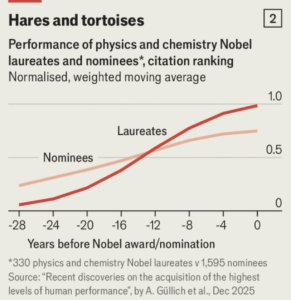
The same was true in other disciplines. Nobel-prizewinning scientists were less likely to have won academic scholarships than those nominated for a Nobel who did not win. They also took longer to reach senior academic positions, had less impressive early publication records, and maintained interest in fields beyond that for which they won their prize (see chart 2).

Why so many exceptional performers show the same pattern of broader interests and later flowering is hard to answer. But the researchers had a stab at it anyway. They scoured the literature on excellence for theories of how it arises, but none seemed compatible with their data. Instead, they offer three of their own.

One is “search and match”, an idea derived from labour-market economics. This holds that having a broad range of interests and waiting before choosing in which to specialise gives a better chance of finding the field best suited to your talents. The young Rafael Nadal—another all-time-great tennis player—flirted with a career in football before plumping for tennis.

A second is “enhanced learning”, the idea that learning is itself a learnable skill, and that a good way to hone it is to pursue a variety of things. When the time comes to focus on one of these, a better ability to learn makes training more effective, which means improvement is faster.

The last possibility is the limited-risk hypothesis, a fancy name for the straightforward idea that avoiding the hothouse, at least for while, may stop youngsters burning out, becoming disenchanted with endless practice or simply getting bored with an activity after spending years pursuing it to the exclusion of all else.

The researchers hope to extend their analysis to more fields of endeavour, such as business and art. In the meantime, Dr Güllich is keen to emphasise that his team is not saying the hothouse model does not work. It is a reliable way, he says, to produce highly competent people—just not the truly world-class ones. Sports academies, selective schools and high-end conservatoires, in other words, may want to rethink how they do things.